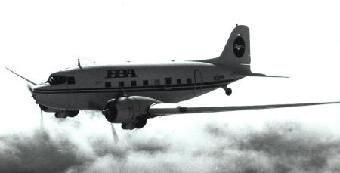
Many pilots regard the DC-3 as psychic and exceptionally forgiving. The plane they say has the knack of anticipating pilot errors and compensating for those mistakes. Some insist it can fly by itself.
In 1957, a USAF DC-3 ran out of gas over Missouri. Everyone bailed out and made it to the ground safely. The DC-3 glided over the horizon and made a perfect, unassisted landing in a cornfield.
While it is very rare for a plane to land without a pilot, it is equally unusual to have monkeys assisting in a landing.
In 1959, John Stevens was flying a planeload of monkeys from Pakistan to Morocco in a DC-3. He ran into a storm, and several crates broke loose, giving the monkeys the run of the airplane. The pilot, concentrating on his flying, did not notice the carnival going on behind him. When the monkeys invaded the cockpit, it was too late for him to do anything. Buttons, switches, and levers were all fair game for the playful primates. Stevens never admitted the monkeys helped land the plane but he said he'd rather fly through a monsoon than with a cockpit full of monkeys again.
In 1959, Southern Airways' mechanics were performing a maintenance inspection on a DC-3. When they pulled the wing, they found a cracked bolt. They changed the bolt and sent the cracked bolt to the Douglas engineers asking for their comments.
The engineers traced the maintenance history of the aircraft and found the bolt was part of the original factory built aircraft 22 years earlier. The engineers said the bolt had a theoretical life of 16,000 hours and the defective bolt had accumulated 64,879 hours before it cracked. The engineers' comment back to Southern was a simple, “Congratulations.”
In 1985, a South African Air Force Dakota made a rough landing on a bush airstrip. It swerved and hit a tree and tore off about three feet of one wing tip. The mechanic on board responsible for the aircraft simply trimmed the rough edges, bound the end with masking tape and the Dakota took off and carried out the rest of its mission.
Major R.G. Houghton was the leader of a three Dakota flight on December 10, 1985. The flight was practicing for the intended 50th Anniversary of the Dakota to take place a few days later.
Shortly after leading his formation into position he experienced a high frequency vibration through the control column, and the aircraft rolled to the starboard. He recovered the aircraft through large rudder inputs as the ailerons seemed to have no effect.
It was then that the copilot informed Major Houghton that the number two aircraft had collided with them, and that about one-third of the aileron and a large portion of the wing tip were missing.
Major Houghton broke formation and after establishing the limits of control, decided to fly a high speed, flapless approach to landing. It turned out that because of the extensive aileron damage, both the pilot and copilot were required to physically effect lateral control for the final approach. The pilot landed the aircraft safely at the airfield.
In 1958, the prestigious Institute of Design of the Illinois Institute of Technology set out to determine the 100 best-designed mass-produced products of modern times. When the researchers had compiled the data, only two aircraft made the list: the Beechcraft Bonanza and the Douglas DC-3.
|