RAILWAY AIR SERVICE
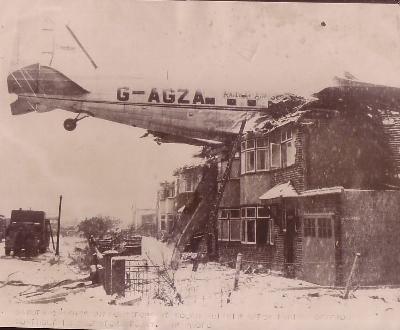
It was a cold, snowy evening at London's airport, when Railway Air Service's G-AGZA, c/n 12455, DC-3 service to Scotland taxied into position for take-off. The snow storm had closed the airport to incoming traffic, and outbound traffic was subject to long delays. The plane had been waiting for more than an hour waiting for clearance. When G-AGZA received clearance, the pilot ran the engines up to 45.5 inches of manifold pressure and 2,500 RPM. Time to go! He released the brakes and the airplane lumbered down the runway, but the old warhorse did not want to make the trip. As the plane gathered speed air rushed over the wings, but the tail did not rise. Both pilots looked at each other, and at the instruments. Then, the tail began its slow, lethargic rise. The pilots relaxed. For a moment, they thought there was a problem.
The old Gooney Bird was having trouble getting off the ground. There was too much ice on her wings. She should not be flying but the pilot didn't listen to her subtle signals. Eighty-four knots and the pilot pulled back gently on the yoke. The Gooney Bird struggled to get off the ground, its Pratt & Whitney engines clawing at the air. She could remember this happening before, but in a war, when she was RAF Dakota KG240. Although struggling, she would fly again, even though the laws of aerodynamics said it was impossible.||
Her wheels left the icy runway and she could feel them tucking away inside her. That helped a little, but not enough. Her propellers were biting at the air, hardly giving her 50 feet of altitude. She was just barely flying.
Suddenly there were houses in front of her and more ice on her wings. Her nose came up a little but it was too late. She hit the roof of the first house with a sickening, scraping noise, but her forward motion continued. She tore the roofs from three more houses before coming to rest on top of the fifth house. Metal and wood groaned under her weight. Then, there was silence.
People came rushing out of their homes. In the distance a baby was crying. The Gooney Bird had nested on top of the last house. Its wing tips were missing but the nose and tail remained undamaged. There were no injuries on the ground, only a frightened baby in its crib, looking up through tear-filled eyes, at the belly of the plane. The three crew members and one passenger walked away from the plane, but instead of in Scotland, their destination, just minutes away from their point of departure. Railway Air removed G-AGZA from the houses, repaired it and put it back into service.
In spite of this incident, many pilots and passengers have called the DC-3, the best bad weather plane in the world. During one flight over the North Atlantic, so much ice accumulated on the skin of a DC-3 that when it landed the ice had to be chipped off the door by the ground crew before the pilots could leave the aircraft.
One DC-3 pilot reported flying backwards when trapped by a violent wind, in an Alaskan valley. Unable to turn or advance, the pilot reported later that he merely throttled the aircraft back and the DC-3, unruffled by the procedure, drifted smartly astern, backing out of the impasse with grace and dignity.
After the war, Britain supplied India with food, and grain to aid its post-war recovery. “I had seen the Dak taxi,” said a Dakota pilot, “and take off quite normally. It surprised me to see it back twenty minutes later. I Jeeped over to the dispersal to find the pilot complaining that the ‘bloody aeroplane won't climb above 4,000 feet.' I poked my head inside expecting to find the normal load of 6,000 pounds of grain, two layers deep. To my surprise, I found someone had loaded a double load. The Dak had grain loaded four layers deep. We had been flying a normal gross weight of 31,000 pounds. This bloke had taken off at 37,000 pounds, and landed at not much less.”
Fred Davies, a navigator on a Dakota, reported, “‘Darkey,' a fellow Welshman, was a good pilot and an old friend. One day he walked into the OPS tent with his crew. I shall never forget his face. It was ashen, and when he tried to speak, he had an unfamiliar stammer.
“He had gotten into some cumulus nimbus (thunderclouds) and lost all control. He had turned over several times, banging his head in the process. Finally he came out, fortunately the right way up, and staggered home.
“When I saw his Dak, I could scarcely believe my eyes. It was a complete write-off. The dihedral angle had increased dramatically, the wings and the fuselage became twisted, and rivets had popped underneath. Thereafter, ‘Darkey' was the most cautious bad weather pilot in the squadron.”
©Copyright Henry M. Holden
|